JLS
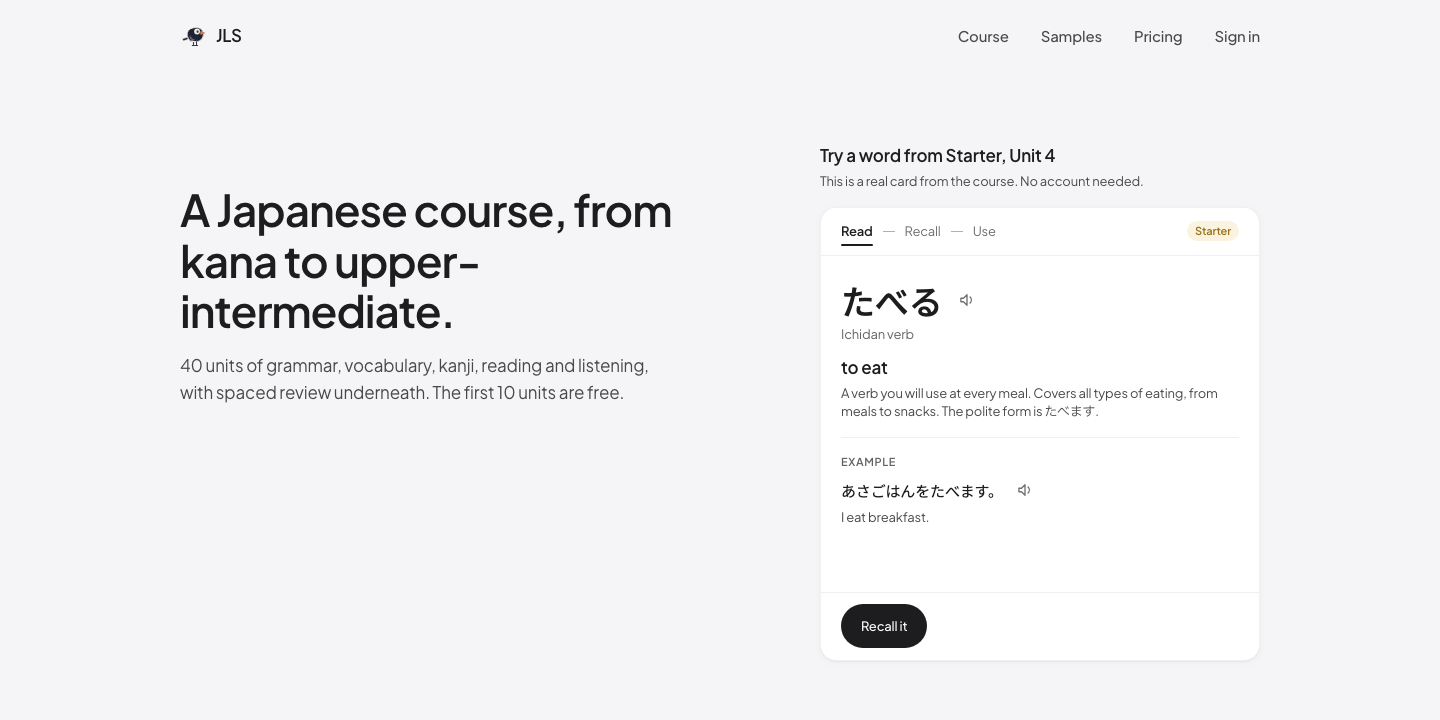
live at jls.studioA Japanese course from kana to upper-intermediate, for learners who want to keep going past the first year.
40 units of grammar, vocabulary, kanji, reading, and listening across four levels, Starter to Mastery, with spaced review underneath. The first 10 units are free; Full Access is a subscription.
Why
I moved to Japan and wanted to study the way a good textbook
teaches, with grammar, vocabulary, kanji, and reading building on
each other in a deliberate order. What I could not find was
something that kept going past the first year, which is exactly when
the plateau arrives.
What I built
The course and the application around it. I wrote the units, built
the app, and run it, and I study with it every day. Audio is
generated with VOICEVOX, so every example sentence has a voice you
can listen to while you study.
How it is built
Next.js on Vercel, with Postgres and auth on Supabase. The stroke
order and dictionary data is derived from open sources, so the
derived data has to be republished under the upstream licenses. That
part took the longest.
Use it:jls.studio
Source:private
Three pieces of it are public, because the licenses ask for it. jls-strokes, stroke order, CC BY-SA 3.0 and OFL 1.1. jls-jmdict-lookup, word lookup from JMdict, CC BY-SA 4.0. jls-kanjidic2-lookup, kanji lookup from KANJIDIC2, CC BY-SA 4.0.